What is Expiratory Muscle Strength Training (EMST)?
EMST is a therapy approach which targets improving the maximal pressure of the expiratory muscles by blowing into a spring-loaded device. The expiratory muscles help us to breathe out and cough with force as well as helping us to swallow safely.
What does EMST do?
Speech benefits of EMST
The resistance provided by the EMST150 device (see below) targets strengthening of the expiratory muscles. This can subsequently improve your breath support which increases voice volume, power and endurance. Being able to produce stronger, more powerful voicing helps others to better understand you.
EMST can also improve mouth and tongue muscle strength which again may support clearer speech.
Swallowing benefits of EMST
Strong expiratory muscles are crucial for safe and effective swallowing. When you swallow, the voice box (larynx) should move upwards and tilt forwards to protect your airway. This reduces the risk of food or drink ‘going down the wrong way’ i.e. into the lungs instead of the stomach. This is known as ‘aspiration’.
To ensure that all food and drinks are cleared through the throat into the oesophagus when swallowing, a high pressure needs to be generated. EMST can help to improve muscle strength and mass required to generate this pressure for safer swallowing.
Enhancing cough efficacy
A strong cough is essential for airway protection i.e. stopping food or drink from reaching the lungs if it enters the airway, subsequently reducing the risk of choking or aspiration.
Improving swallow safety and cough strength can lead to improved quality of life.
Who might benefit from EMST?
The EMST150 may be useful for people who (including but not limited to):
- Have neurological conditions: Such as stroke, Motor Neurone Disease, Parkinson’s and Multiple Sclerosis. These conditions often lead to respiratory muscle weakness.
- Have age-related loss of muscle strength.
- Are professional voice users or athletes: to improve breath endurance and vocal power.
The precautions and contraindications for use of the EMST150 are detailed here:
https://emst150.com/wp-content/uploads/2021/03/Contraindications-11-2019.pdf
How does EMST work?
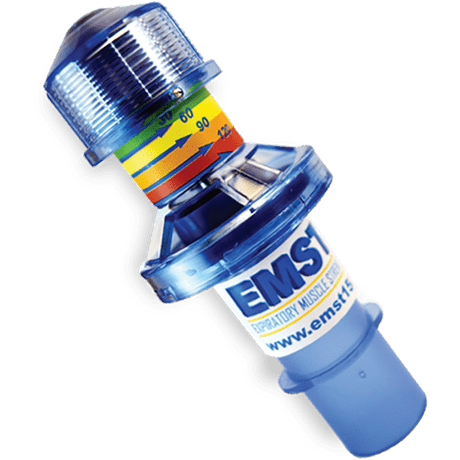
The EMST150 device (pictured below) is effective in improving expiratory muscle strength through:
- Forming of a tight seal: The user places the device’s mouthpiece in their mouth and seals their lips around it.
- Exhaling against resistance: The user then exhales forcefully through the device.
- Use of a spring-loaded valve: The device contains a spring-loaded valve that provides resistance. It can be calibrated to the individual’s ability and is adjusted as therapy progresses.
- Producing a distinctive release sound to signal success: A distinct ‘puff’ sound indicates that the user has exhaled with enough force to open the valve and complete a repetition.
How long should I use the device for?
Speech and Language Therapy will guide you on how often you should continue the exercises and how many repetitions (i.e. number of breaths) are required.
Once a treatment programme is commenced, we will ensure that a review is arranged to assess your progress and give further guidance.
In some cases, you will be encouraged to continue the exercises in the longer term for ‘maintenance’.
How do I know EMST will be effective?
EMST is based on the principles of neuroplasticity – the brain’s ability to adapt its pathways to compensate for areas of difficulty. It incorporates intensity, repetition and progressive muscle overload.
EMST is a form of resistance training. Resistance training is known to be highly effective in improving muscle strength and mass when compared with traditional strength training methods, in this case speech or swallowing exercises.
Research evidence around efficacy
Recent research evidence has demonstrated benefits in speech and swallowing function in people with Motor Neurone Disease (MND), Parkinson’s and stroke. Outcomes from this research include:
- Improvement in expiratory pressure and swallow function for people with MND (Plowman et al., 2016)
- Reduction in airway penetration (food/fluid entering the airway) and aspiration in people with various neurological conditions (Wang et al., 2019)
- A clear improvement in cough and swallow for people with Parkinson’s (Pitts et al., 2009 and Byeon, H. 2016)
- Sustained improvement in expiratory pressure in the longer term after 4 weeks of EMST for people in the earlier stages of Parkinson’s (Saleem et al., 2005)
- Improved laryngeal lift and reduced pharyngeal food/fluid residue – leading to reduced risk of aspiration – in people with swallowing difficulties post stroke (Moon et al., 2017 and Eom et al., 2017)
EMST was included in the most recent National Institute for Health and Care Excellence (NICE) guidance for Parkinson’s (2017), stating that providers should:
“Offer speech and language therapy for people with Parkinson’s disease who are experiencing problems with communication, swallowing or saliva. This should include: strategies to improve the safety and efficiency of swallowing to minimise the risk of aspiration, such as expiratory muscle strength training (EMST)”
Where can I purchase an EMST150 device?
The EMST150 devices are approximately £75 to purchase and are available online. They are for single person use and are recommended to be cleaned monthly using warm water and washing up liquid only.
Support available from VISTA SLT
At VISTA SLT, we regular introduce EMST programmes with our clients. We have seen great results for our clients ranging from reduced need for diet and fluid modifications due to improved swallow safety to stronger and more consistent voicing in conversation. One of our clients has reflected on significant improvements in her confidence to communicate with others after improving her breath support for clearer speech using EMST.
If you would like more information about EMST or want support and guidance on introducing EMST at home, please do not hesitate to contact us.
Still unsure about private Speech and Language Therapy? Read our previous blog post for more information about the benefits of independent SLT.
References
Antonsson, M. et al. (2023) ‘Effect of expiratory muscle strength training on voice and speech: An exploratory study in persons with Parkinson’s disease or multiple sclerosis’, International Journal of Speech-Language Pathology, 26(4), pp. 475–492. doi: 10.1080/17549507.2023.2243402.
Brooks M, McLaughlin E and Shields N (2019) ‘Expiratory Muscle Strength Training Improves Swallowing and Respiratory Outcomes in People with Dysphagia: A Systematic Review’, International Journal of Speech and Language Pathology 21 (1): 89-100
Byeon, H. (2016).Effect of simultaneous application of postural techniques and expiratory muscle strength training on the enhancement of the swallowing function of patients with dysphagia caused by parkinson’s disease. Journal of Physical Therapy Science, 28(6), 1840–1843. http://doi.org/10.1589/jpts.28.1840
EMST (2018 online) EMST How It Works. Online.
Eom, M.-J., Chang, M.-Y., Oh, D.-H., Kim, H.-D., Han, N.-M. and Park, J.-S. (2017). Effects of resistance expiratory muscle strength training in elderly patients with dysphagic stroke. NeuroRehabilitation, 41(4), pp.747–752. doi:https://doi.org/10.3233/nre-172192.
Kuo Y, Chan J and Bernard J (2017) ‘Effect of Expiratory Muscle Strength Training Intervention on the Maximum Expiratory Pressure and Quality of Life of Patients with Parkinson’s Disease’, Neurorehabilitation Journal 41 (1): 219-226
Laciuga H, Rosenbek J, Davenport P and Sapienza C (2014) ‘Functional Outcomes Associated with Expiratory Muscle Strength Training: Narrative Review’, Journal of Rehabilitation Research and Development 51 (4): 535-540
Moon, J.H., Jung, J.-H., Won, Y.S., Cho, H.-Y. and Cho, K. (2017). Effects of expiratory muscle strength training on swallowing function in acute stroke patients with dysphagia. Journal of Physical Therapy Science, 29(4), pp.609–612. doi:https://doi.org/10.1589/jpts.29.609.
NICE (2017). Parkinson’s disease in adults NICE guideline. [online] Available at: https://www.nice.org.uk/guidance/ng71/resources/parkinsons-disease-in-adults-pdf-1837629189061.
Plowman, E.K., Watts, S.A., Tabor, L., Robison, R., Gaziano, J., Domer, A.S., Richter, J., Vu, T. and Gooch, C. (2016). Impact of expiratory strength training in amyotrophic lateral sclerosis. Muscle & Nerve, 54(1), pp.48–53. doi:https://doi.org/10.1002/mus.24990.
Pitts, T., Bolser, D., Rosenbek, J., Troche, M., Okun, M.S. and Sapienza, C. (2009). Impact of Expiratory Muscle Strength Training on Voluntary Cough and Swallow Function in Parkinson Disease. Chest, 135(5), pp.1301–1308. doi:https://doi.org/10.1378/chest.08-1389.
Saleem, A. F., Sapienza, C. M., & Okun, M. S. (2005). Respiratory muscle strength training: treatment and response duration in a patient with early idiopathic Parkinson’s disease. NeuroRehabilitation, 20(4), 323–333.
Wang, Z., Wang, Z., Fang, Q., Li, H., Zhang, L. and Liu, X. (2019). Effect of Expiratory Muscle Strength Training on Swallowing and Cough Functions in Patients With Neurological Diseases. American Journal of Physical Medicine & Rehabilitation, 98(12), pp.1060–1066. doi:https://doi.org/10.1097/phm.0000000000001242.
Leave a Reply
You must be logged in to post a comment.